Yamantaka Puja 2010
Февраль 7, 2010
For the first time in the history of Kunzang Palchen Ling, the center hosts the full array of pre-Losar ceremonies that will be followed by Losar celebration on the morning of February 14.
Starting on February 6, the Yamantaka reatreat has been in progress. That includes a tsok and a Mahakala puja at the end of the day. On the first day of the puja, a group of female students sang a tsok song that was composed by Bardor Tulku Rinpoche. This was the first time this song has been chanted. It will be performed again on the last day of the puja.
148 3
29,461 просмотров

Drukpa Mahakala Offering - Dance & Burning Of Torma
Druk Amitabha Mountain Sep 2010
Cúng dường Mahakala tại Druk Amitabha — phần lễ rước và hỏa tịnh Torma.
75 2

Buddhist nyingmapa lama performing Guru Rinpoche prayer in Nepal
This is a nyingmapa buddhist lama prayer conducted for death ritual in Nepal.This puja is done specially after 3, 7, 14 and 21 days up to 49 days after the death. Lama are playing bells, drums, cymbals, gyaling in the puja
222 11

Atsara/Vajrakila/Mahakala Puja at Kunzang Palchen Ling
In preparation for a special program that will be held for the first time in the new building at Kunzang Palchen Ling (KPL), a four day Atsara/Vajrakila/Mahakala puja was held from September 20 to 23, 2010. The new building at KPL is still under construction, but the library has been completed and it will serve to host special events.
To learn more about the four-day puja, please read a story on our website: http://www.kunzang.org/news.html#atsara.
If you are inspired to help us complete the new building, please periodically visit our home page for information about volunteer opportunities: http://www.kunzang.org/index.html#volunteers.
For information about other ways to support the construction, please visit the construction and donation page: http://www.kunzang.org/construction.html.
Thank you for your support!
19 0
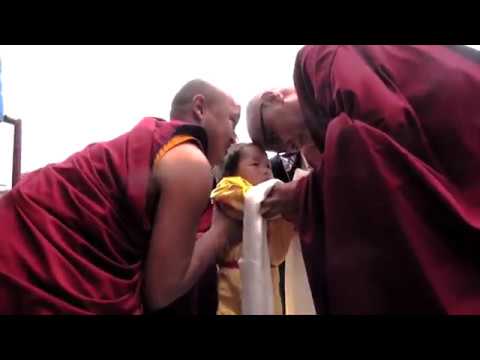
Tenga Rinpoche's Yangsi Rinpoche at Benchen monastery
On 12th of February 2018 Tenga Rinpoche’s Yangsi arrived at Benchen Monastery to observe the annual Mahakala Puja and Lama dance.
112 5
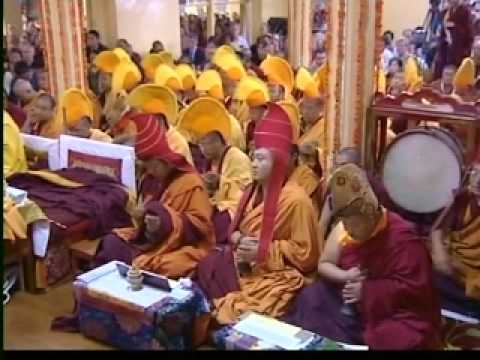
Nyingmapa Tenshu to H.H The Dalai Lama
The whole Nyingmapa gathered at Dharamshala, H.P, India to offer Tenshu( Long life ceremony) to H.H The XIVth Dalai Lama. Trulshig Rinpoche, Tsetrul Rinpoche, Mindrolling Khenchen Rinpoche, Sechen Ramjam Rinpoche, Dzogchen Rinpoche, Kathok Getse Rinpoche, Dilgo Khentse Yangsi Rinpoche, Dudjom Yangsi Rinpoche and many other tulkus, khenpos, monks and nuns from various monastery throughout the world attended the ceremony. The ceremony was conducted on the basis of Mindrolling custom.
264 17

Vajrapani Mantra
Vajrapani (Sanskrit; tibetisch: phyag na rdo rje (Chagna Dorje); Halter des Vajra) ist einer der „acht großen Bodhisattvas" des Mahayana-Buddhismus. Er wird insbesondere im tibetischen Buddhismus angerufen, wo er auch als „Herr der Geheimnisse" gilt und zur Vajra-Buddhafamilie gehört.
Nach einer Theorie soll Vajrapani vom indischen Regen- und Kriegsgott Indra, aus dessen Blitzzepter sich dann der Vajra entwickelte, abgeleitet sein. In frühen, griechisch beeinflussten Darstellungen aus Gandhara (ab dem 1. Jh. u. Z.) wird Vajrapani noch als eine Art Leibwächter des historischen Buddha dargestellt, der an Herakles erinnert. Er ist dann ein muskulöser und bärtiger Mann, dessen Vajra eher einer großen Keule gleicht. Seine heutige Form wurde erst in späterer Zeit durch den Einfluss des Vajrayana herausgebildet.
Vajrapani gilt als die Verkörperung der Tatkraft aller Buddhas. Daher wird er meist in stehender, zornvoller Haltung abgebildet, die seine Aktivität symbolisiert. Seine Tatkraft enthält jedoch auch einen großen Aspekt von Weisheit, die durch das dritte Auge, sowie die ihn umgebenden Weisheits-Flammen dargestellt werden. Die Schlangen, die in den meisten Darstellungen um seinen Hals hängen, stehen für seinen durch die Weisheit kontrollierten Zorn. Buddha Vajrapani, in dieser Form auch als „Herr der Geheimnisse" (tibetisch: gsang bdag phyag rdor; Sanskrit: Guhyapati) bekannt, soll auf dem Berg Malaya die Tantras nach dem Tode Buddhas an sechs Wesen der sechs Bereiche übermittelt haben. Sein Bereich wird Changlochen genannt.
Bild von einem tibetischen Thangka
Er erscheint in seiner friedlichen Form zweiarmig zusammen mit dem Bodhisattva Padmapani an der Seite von Buddha Amitabha im Reinen Land von Dewachen. Oft wird er auch in seiner zornvollen Form, mit Vajra in der Rechten und Fangschlinge in der Linken, von einem Feuerkranz umgeben dargestellt.
Quelle: wikipedia
Links:
http://www.facebook.com/DharmaGermany
322 11
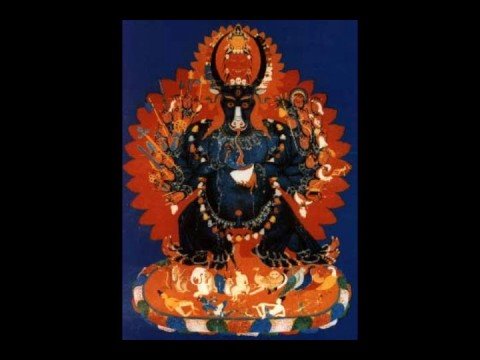
Yamantaka Terminator of Death
Gyuto Monks chant to invoke Yamantaka for deep meditation.
471 16


Yamantaka-Vajrasattva Mantra (100 Syllable)
Facebook : http://www.facebook.com/thebuddhismonline
Visit us on : http://www.buddhism.uk
Instagram : http://www.instagram.com/buddhismonline
具德金刚令怖畏尊佛Yamantaka大威德金刚之百字明咒
130 5
![Tantra of Gyuto - Sacred Rituals of Tibet (1968) [Full Documentary]](https://i.ytimg.com/vi/qUmU-AL2GMI/hqdefault.jpg)
Tantra of Gyuto - Sacred Rituals of Tibet (1968) [Full Documentary]
Monks of the Gyuto Tantric College perform sacred Tibetan Buddhist ceremonies in a style of chanting that expresses the ecstasy of true meditation. http://facebook.com/Awakened
Through ritual and mantric power and by their sheer inherent potency and disciplined execution, these concentrated essential energies bring about direct spiritual phenomena.
The rituals, introduced by the Dalai Lama, are interwoven with powerful images of Tibetan sacred art.
The film is prefaced by an account of Tibetan history that incorporates archival footage from the 1920s until the Chinese takeover of Tibet in 1959.
Uploaded under the policy of Fair Use, Freedom of Information & Freedom of Speech. This video material is for informational, educational and non-profit purposes only.
854 22
